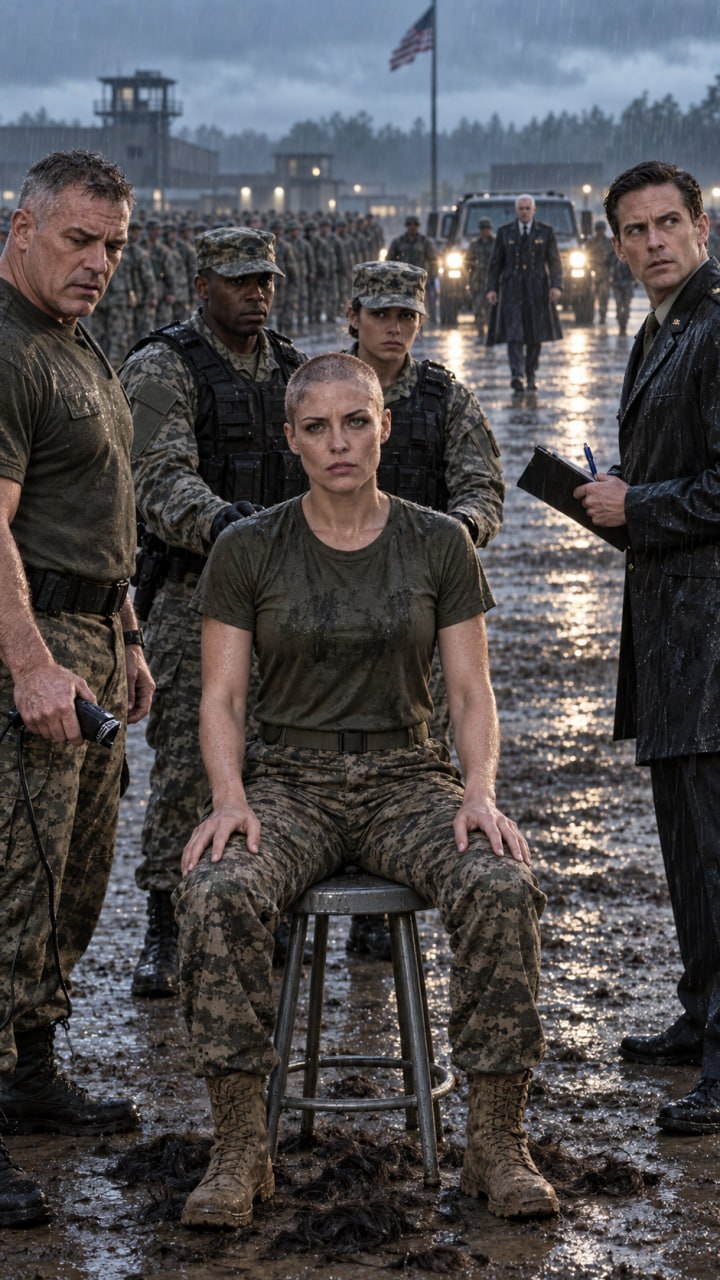
The preliminary hearing began the next morning in Blackridge’s largest lecture room.
No gavel struck. No flags moved dramatically. Folding tables faced one another beneath flat institutional lights. Ellery presided with two legal officers beside him. Crowley and Knox sat separately under security supervision, their access badges still clipped to their uniforms but electronically suspended.
The gallery filled before 0700.
I wore a clean replacement uniform without rank. My scalp showed uneven dark stubble where the clippers had passed. I could have covered it. I chose not to.
Before the legal officers entered, Jensen stopped beside my chair. He asked whether he should call me ma’am, investigator, or recruit. The question was not about etiquette. He needed to know which version of me would sit in the room while he spoke.
“Cross is fine,” I said.
He glanced toward Crowley’s table. “What if I forget something?”
“Say what you remember. Say when you are uncertain. Do not improve the truth for anyone in this room, including me.”
Jensen absorbed that, then nodded. The instruction gave him something fear had taken away: permission not to perform.
Jensen testified first.
His right hand trembled beside the tabletop microphone. He curled it into a fist, opened it, and began with Barracks C.
He described the wet mattress and Knox’s order that no one help me. He admitted that he had crossed the aisle with the gray blanket during the camera’s blind interval. Then he described the threat to recycle his platoon, the midnight attack, and the order on the parade deck.
His voice broke when he reached the names of injured recruits.
“Miller didn’t quit,” he said. “He couldn’t lift his arm. They made him sign a failure statement before they sent him away.”
One of the legal officers asked how he knew.
“I carried his bag to transport.”
Jensen looked toward the gallery. “Parker filed a complaint. After Major Crowley met with him, Parker said none of it happened. But it happened.”
The last three words came out steadier than everything before them.
Ruiz testified next. Then the range assistants, Bell, Davis, and the MP who had surrendered Crowley’s message. Each account made the following one easier, not because fear disappeared but because truth stopped sounding solitary.
By midday, Crowley’s attorney requested permission for him to respond.
Crowley stood. His uniform was immaculate again, but the blue pen was gone from his pocket.
“Special Investigator Cross entered this command under false pretenses,” he said. “She disobeyed direct orders, manipulated recruits, and provoked incidents to manufacture a case.”
He spoke toward Ellery, but his eyes kept moving to the gallery.
“She admits she refused an order in formation.”
“Correct,” I said.
The room shifted.
Crowley’s shoulders eased. The corner of his mouth lifted, almost the same expression he had worn in the intake office. He believed I had finally given him a clean fact.
I waited until that belief became visible.
“The order required me to strike an exhausted teammate for your entertainment,” I continued. “It was unlawful, witnessed, and followed by retaliation carried out through military police. My refusal did not create your pattern of abuse. It exposed it.”
Crowley’s hand dropped from the edge of the table.
His expression remained confident for a fraction of a second after the confidence itself was gone. Then he turned toward Knox as if the instructor might still absorb the blame.
Knox looked at the floor.
The legal officers reviewed the message record, the mail log, the equipment report, the camera schedule, and the duplicate medical files. No single item carried the case. Together, they formed a system: isolate a target, provoke a reaction, rewrite the event, pressure witnesses, and remove anyone who resisted.
Ellery recessed the hearing for twenty minutes.
When he returned, everyone stood.
“Major Adrian Crowley and Sergeant Raymond Knox are relieved of duty pending formal charges and full investigation,” he said. “Their access to Blackridge personnel, facilities, records, and trainees is revoked effective immediately.”
Security approached from the established aisle.
An officer held out a hand to Crowley. The major stared at it before understanding. Then he unclipped his badge and placed it in the officer’s palm.
Knox removed his own more slowly.
The two pieces of plastic made almost no sound. Still, the room seemed to hear the locks changing behind them.
There was no applause.
Jensen sat in the front row with the gray blanket folded across his knees. When security escorted Crowley and Knox toward the exit, he did not watch them leave. He looked at the witnesses who had spoken after him.
The first voice mattered because it made room for the second.
By the time the doors closed, Jensen was no longer shaking.
Comments (0)