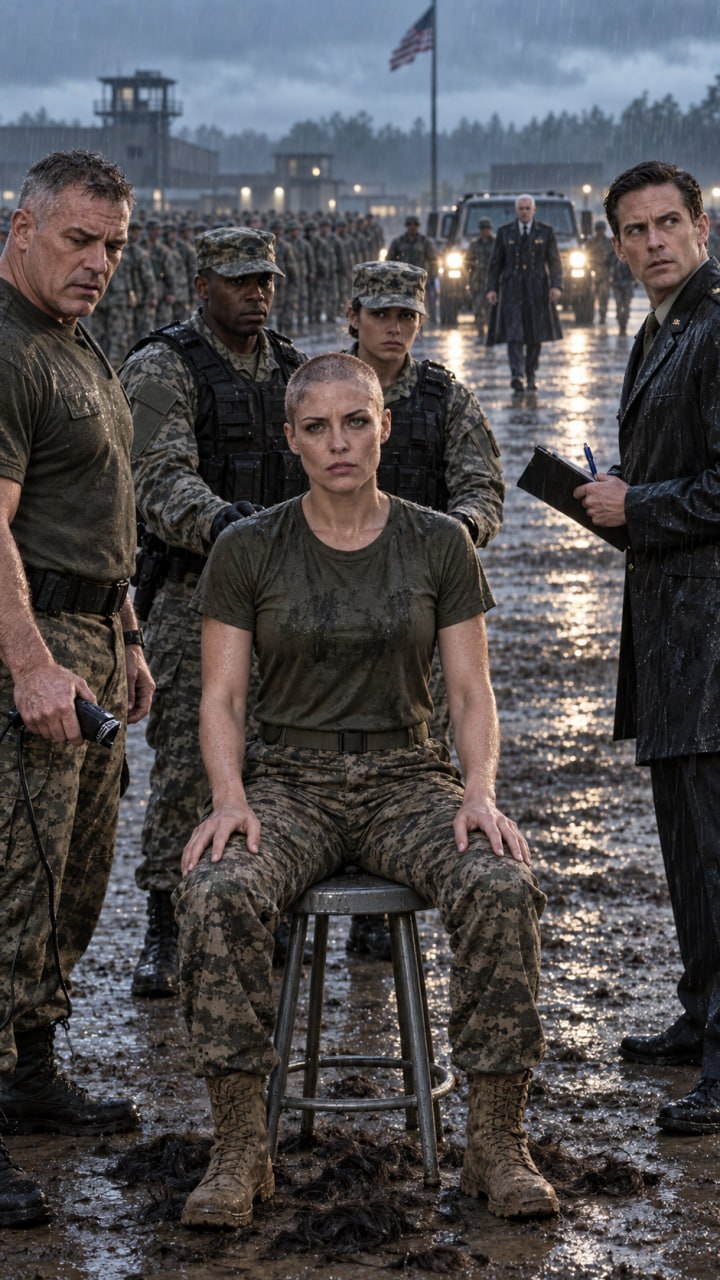
Crowley and Knox remained loyal to each other for forty-three minutes.
Security placed them in separate rooms divided by a glass partition. Crowley insisted every punishment had served a legitimate training purpose. Knox claimed he had enforced standards established by the major. Each man spoke calmly until he realized the other had begun assigning blame.
Then calm became detail.
Crowley described Knox as unstable. Knox listed orders Crowley had given without witnesses. Crowley said the shaving had been an instructor’s improvisation. Knox demanded investigators examine the message on the MP’s phone.
I listened from Crowley’s office while the search team opened his locked cabinet.
The cabinet stood behind the desk beneath a framed statement about honor. Its key was not on Crowley’s ring. Investigators found it taped beneath the lower desk drawer, exactly where someone hides an object they still expect to reach easily.
Inside were two sets of records.
The official files described voluntary withdrawals, poor motivation, accidental injuries, and transfers requested for personal reasons. A second group of working papers carried different notes in Crowley’s blue ink: refused pressure, family contacted, medical rewrite, relocate before review.
Miller’s shoulder injury appeared as a failure to follow climbing instructions. A handwritten margin note stated that Knox had continued the drill after the trainee reported numbness in his arm.
Parker’s complaint form was there too.
The signature withdrawing it did not match the signature on his intake documents.
An investigator laid both pages side by side. “We’ll need handwriting analysis.”
“Preserve the originals and the cabinet seal,” I said. “Photograph position before removing anything else.”
The broken radio rested on an evidence mat beside Crowley’s report. Under stronger light, the damage told its own sequence. Concrete dust sat inside the first fracture. The wider split from Crowley’s boot crossed it at a different angle. His partial sole print remained along the edge. The report’s blue signature fixed the lie to a time when both range assistants had seen the truth.
Ellery stood beside me while his aide documented the inventory.
Through the partition, Crowley saw the radio and stopped talking.
Knox followed his gaze. “That was him,” he said through the glass. “I never touched it.”
Crowley turned slowly toward him. “You used the hose.”
“Because you told me to.”
Neither seemed to notice how completely they had abandoned the language of discipline.
Ellery closed the office door.
For a moment, the room held only rain, paper, and the quiet electrical hum of the secure tablet.
“You had enough before the parade deck,” he said.
It was not an accusation, but I heard the question beneath it.
“Enough for an inquiry,” I said. “Not enough to show command involvement beyond deniable reports.”
“You let them shave you.”
“I refused an unlawful order in front of three hundred witnesses. Crowley responded by directing MPs to enforce a public punishment. He made the connection visible.”
Ellery looked toward the dark window. “There had to be another line.”
“There was. Jensen.”
If Crowley had ordered me to hit Jensen again, or if the MPs had used force that threatened lasting injury, I would have ended the cover. The operation never required sacrifice without limit. It required judgment under pressure, which was more difficult to explain after the pressure was gone.
Ellery’s aide placed the secure tablet on the desk and reopened my classified file. “The preliminary report will require an identity basis,” she said. “Limited disclosure is authorized.”
Rows of sealed assignments appeared beneath the red clearance banner. Operations, locations, and names unavailable to everyone outside the room.
Ellery looked at me. “Do they need to know the rest?”
The question was not about legal sufficiency. He was offering me public restoration after three days of being called nobody.
I thought of Mara’s burned letter. Daniel walking across his kitchen. Men and women whose survival depended on their stories remaining sealed. The missing pages did not belong only to me.
“No.”
His aide darkened the screen.
“Special Investigator is enough,” I said. “The case should stand on what they did, not on what I did before I came here.”
Ellery nodded once.
Through the partition, Crowley and Knox sat with their backs turned to each other. Between them, their reflections overlapped in the glass until it looked as though each man occupied the other’s chair.
The nearly empty folder had allowed them to invent my value.
The records in Crowley’s cabinet showed how many times they had done the same to others.
Comments (0)