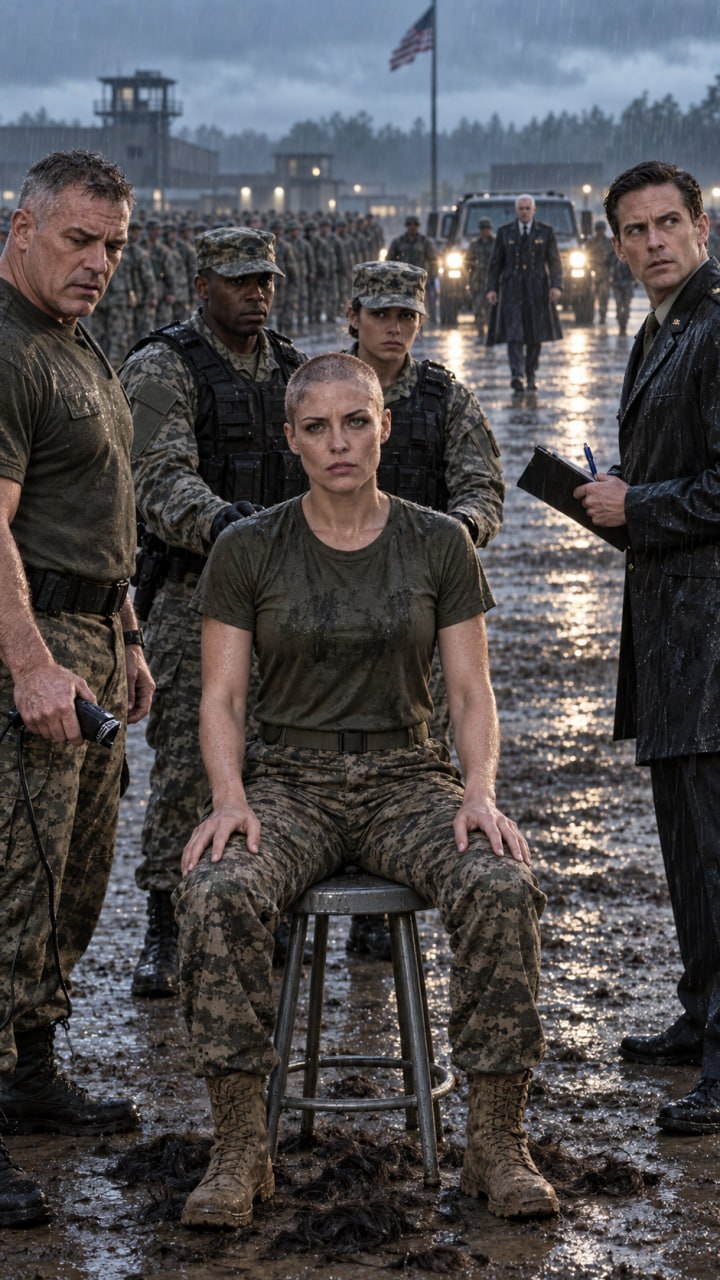
One week later, rain still darkened the parade deck, but the stool was gone.
So were Knox and Crowley. They had been transferred to a secure holding facility while formal investigators expanded the case beyond the three days I spent at Blackridge. Independent officers reopened every injury, withdrawal, transfer, mail complaint, and equipment charge from the previous two years.
The work produced no clean ending.
Some former recruits refused to return calls. One had moved overseas. Another said he wanted nothing from the military except to be left alone. Parker agreed to provide a statement only after receiving written assurance that Crowley could not contact him. Miller’s shoulder had never fully recovered.
Accountability could open a locked door. It could not restore everything taken behind it.
Blackridge changed in smaller, visible ways.
The corridor cameras remained, but recruits could request footage preservation through an office outside the training chain. Medical evaluations no longer passed through Crowley’s staff. Complaint interviews required two certified observers. Personal mail moved directly from the clerk to the recipient.
Ruiz had written that last rule herself.
In the mess hall, recruits no longer abandoned a table when someone under scrutiny approached. The change was awkward rather than inspiring: trays shifted, conversations faltered, and people made space without knowing what to say. That was enough. A healthier command did not require instant courage. It required room for better choices before fear closed around them.
The company assembled before I left. They stood in relaxed formation rather than rigid ranks, uncertain what was expected of them without Knox shaping every silence.
My hair had begun growing back as uneven dark stubble. I wore the same rankless uniform. Special Investigator was now known, but I had no interest in dressing the farewell as a ceremony.
Jensen stood in the front row.
I carried the folded gray blanket toward him.
He looked at it, then at me. “You kept it.”
“It was evidence.”
That answer disappointed him, so I added, “It was also warm.”
For the first time, I saw him smile.
I presented the blanket with both hands. Jensen took hold before I released it, the same careful transfer he had made beneath my bunk. He folded it once against his chest.
“Your statements will remain in the record,” I told the company. “So will every attempt someone made to erase them.”
Bell stood near the second rank. Davis beside him. Ruiz waited by the administration steps with her mail bag. The range assistants had returned to duty under a temporary commander. Even the MP who had held my right arm stood at the edge of the group, awaiting his own review.
No one looked comfortable. Comfort was not the point.
“Some of you followed orders you knew were wrong,” I said. “Some of you stayed silent. Some of you helped when helping carried a cost. The investigation will distinguish those choices. You should too.”
Jensen adjusted the blanket beneath one arm and raised a careful salute.
I returned it.
Ellery waited beside the command Jeep at the flagpole. As I approached, he opened the rear door but did not enter.
“Last chance,” he said. “I can authorize a summary of your personnel history. Enough to answer their questions.”
I looked back at the company.
For three days, Knox had treated the blank spaces in my file as permission. Revealing the classified pages might have reversed the humiliation, but it would also accept his premise—that a person needed extraordinary history before cruelty became unacceptable.
“They saw what mattered,” I said.
Ellery followed my gaze and understood.
I climbed into the Jeep. He entered after me, and the vehicle pulled away through the light rain.
At the edge of the parade deck, the new commander called the company back to training. Recruits broke formation and moved toward the obstacle lane.
One young man stumbled as he stepped off the wet concrete. His boot slipped, and his knees began to fold.
Two recruits reached him before he hit the ground.
One caught his upper arm. The other braced his shoulder. They held only until he found his balance, then released and let him stand under his own weight.
No instructor shouted. No one laughed. No clipboard appeared to rename the moment weakness.
Jensen watched from a few steps away with the gray blanket under his arm. When the recruit was steady, Jensen turned and continued toward the training lane beside him.
The Jeep rounded the administration building, and Blackridge disappeared from view.
My classified pages would remain sealed. The recruits would never know where I had served, what I had survived, or whose lives were hidden inside the empty spaces.
They did not need to.
For the first time, they had a record of their own.
Comments (0)