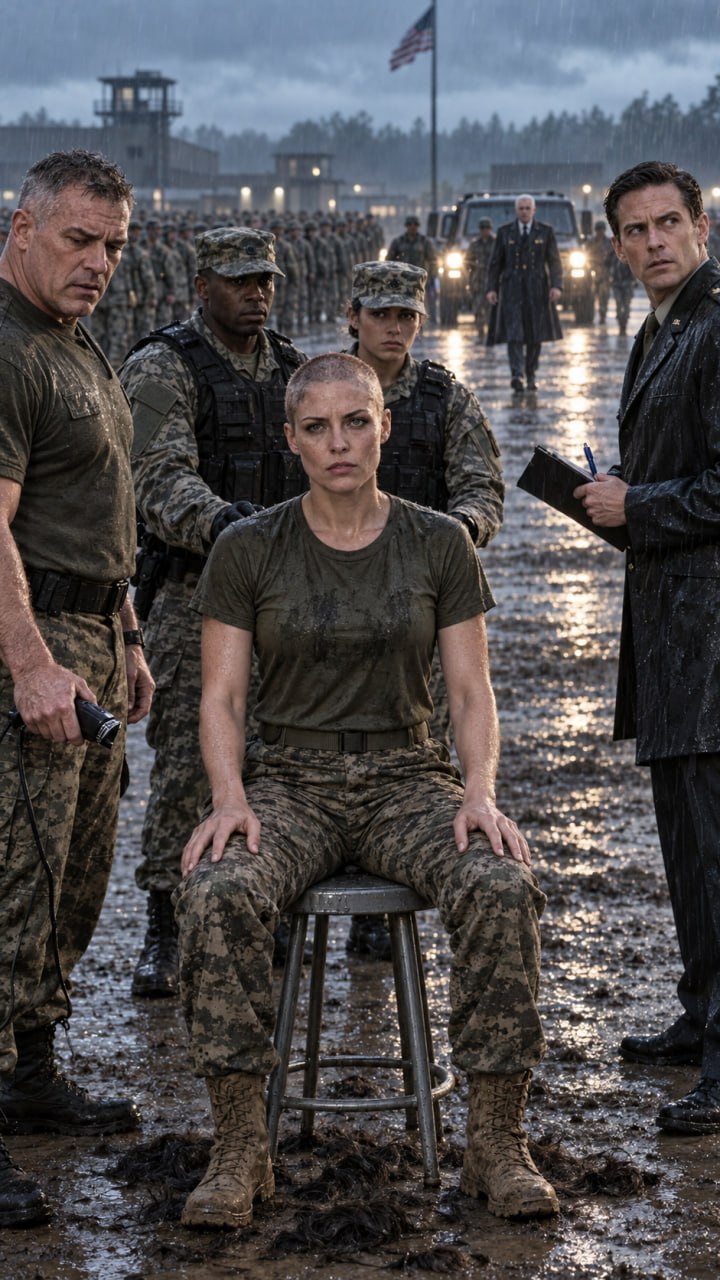
By noon, someone had poured dirty mop water over my mattress.
The gray liquid soaked through the thin fabric and collected between the metal springs. My spare uniform lay crumpled beneath a pair of boots that did not belong to me. The door of my locker had been bent outward at the hinge, leaving a gap wide enough for anyone passing in the aisle to see everything I owned.
There was not much to see.
Two folded uniforms. A hygiene kit. A paperback with the cover removed. The dark duffel, now empty except for an ordinary towel. The credential sewn inside its lining had moved to a concealed pocket before I entered the barracks.
Knox stood at the end of the aisle with his arms folded. “Problem, Cross?”
The recruits closest to me watched with careful faces. Some expected anger. Others looked frightened by the possibility that I might name whoever had done it.
I pressed two fingers into the mattress and watched water rise around them. “No, Chief.”
“Good. Unit correction builds awareness.”
Crowley appeared in the doorway behind him, clipboard already in hand. “Or perhaps an opportunity to adapt.”
I looked at the slow wall clock. 1217 hours. Barracks C. Twelve direct witnesses. Knox present. Crowley present. Camera pointed away during the likely act, but its rotation schedule could establish the available window.
“Understood, sir.”
Disappointment moved across Knox’s face before he covered it with a grin.
I lifted my spare uniform from beneath the boots, shook off the dust, and folded it again. The owner of the boots, a broad recruit named Bell, kept his eyes forward. His left cheek twitched. I did not know whether he had damaged my bunk or had simply been ordered to stand there. Accusing him would have served Knox either way.
For the rest of the afternoon, no one spoke to me unless an instructor could hear. At equipment issue, the recruit ahead of me stepped aside so late that I nearly walked into a crate. In the laundry room, someone removed my clothing from a machine while it was still wet and left it on the floor. Each action was small enough to deny and public enough to teach the same lesson: distance yourself from Cross.
That evening, I carried my tray into the mess hall and saw three empty seats at a table meant for six. As I approached, the recruits occupying the other side stood together and moved to another table.
Jensen remained behind for half a second too long.
He was nineteen, thin through the shoulders, with a sandy buzz cut and the exhausted pallor of someone who had not slept properly in weeks. His eyes moved from me to Knox at the officers’ table. Then he picked up his tray and followed the others.
I ate alone.
Back in Barracks C, the wet mattress smelled of old disinfectant and floor grime. I propped it against the wall, wiped the frame, and stretched my towel over the exposed springs. Laughter came from the shower room, too loud and too evenly timed to be natural.
At 2200, the lights went out.
Darkness made the barracks honest. Beds creaked. Someone coughed into a blanket. Whispered conversations began and stopped whenever boots passed in the corridor.
From two rows away, a recruit said, “Miller didn’t quit.”
Another voice answered, “Shut up.”
“I saw his shoulder.”
“You didn’t see anything.”
Silence followed. Then a third voice, lower than the others: “Parker filed a complaint. Crowley called him in. Next morning, he withdrew it and requested transfer.”
The words matched the sealed reports Ellery had shown me, but the names did not. That meant the three known complaints were not the beginning. They were only the ones that had escaped Blackridge.
I lay on the bare springs and listened until my weight drove the metal through the towel and into my back.
The camera above the central aisle moved with a soft electric hum. Forty seconds toward the showers. Three seconds stationary. Forty seconds back toward the entrance. Its blind area passed beneath my bunk and extended across the aisle.
On the fourth cycle, fabric whispered against the floor.
Jensen slid from his bunk opposite mine with a folded gray blanket tucked against his chest. He waited until the lens began turning toward the entrance, crossed the aisle, and crouched without looking directly at me.
“You’ll need it,” he murmured.
He pushed the blanket beneath the frame. His hand remained on it until it cleared the aisle, then released.
I almost thanked him.
The camera motor changed pitch.
Jensen heard it too. His shoulders tightened, and he moved back across the aisle before the lens returned. By the time it faced us, he was lying on his bunk with his back toward me.
I pulled the blanket over the springs. It smelled of laundry soap and dust. More important, it carried a decision. Jensen had risked collective punishment to give comfort to the person Knox wanted isolated.
I did not look at him again that night.
Instead, I watched the camera complete another sweep and counted to forty in the dark.
Comments (0)