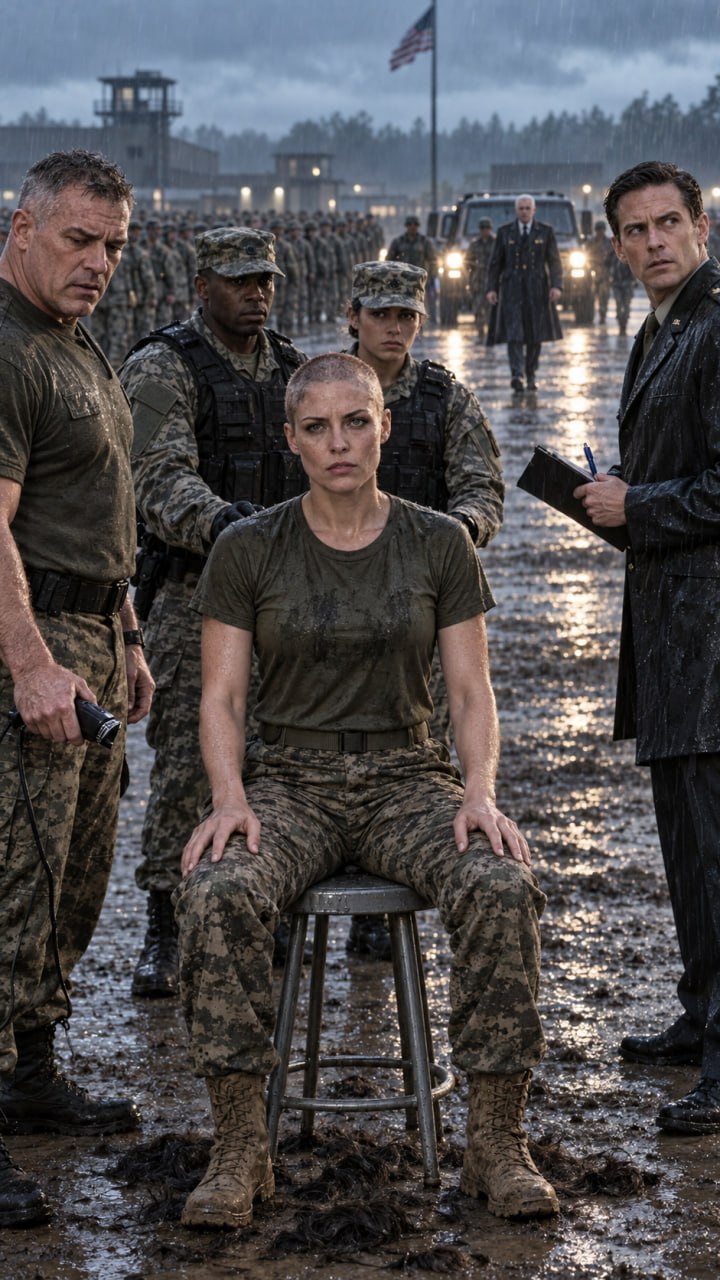
The first thing Sergeant Raymond Knox did was turn my personnel folder upside down.
He held it over the steel desk and shook it twice, as if a medal, a citation, or an entire missing career might fall out. Three sheets slid free and landed beneath the fluorescent light. One carried my name. One carried my transfer order. The last contained a medical clearance so spare it could have described a machine instead of a person.
Knox looked at the pages, then at me. “That’s it?”
I kept both hands loose beside my duffel. “That’s what they sent.”
The intake office at Blackridge Training Command had no windows, only gray cinderblock walls and a clock that ran four minutes slow. A camera above the door swept from the desk to the filing cabinets and back again. Major Adrian Crowley stood beneath it with a clipboard pressed to his chest. He had the polished stillness of a man who preferred other people to do his dirty work while he supplied the paperwork.
Knox flipped through the three sheets once more. “No rank. No previous assignments. No awards. No medical history worth mentioning.” He tapped the empty side of the folder. “They sent me a ghost.”
Two clerks near the filing cabinets tried not to smile. Crowley did not bother trying. The corner of his mouth lifted while his blue pen hovered over the intake checklist.
Knox leaned back. “What are you, sweetheart? Some kind of paperwork mistake?”
“I’m here for training, Sergeant.”
The clerks stopped smiling.
It was not the words that changed the room. It was the absence of apology in them. Men like Knox learned to recognize fear before they learned a recruit’s name. When they could not find it, they often mistook composure for defiance.
His chair scraped forward. “Not Sergeant. Chief.”
Chief was not his rank. It was a title attached to his position as senior training instructor, and he wore it more proudly than any official insignia. The sealed briefing had warned me about that preference. It had also warned me about the three complaints that vanished after entering Crowley’s office, the unexplained transfers, and the injuries rewritten as failures of motivation.
“Chief,” I corrected.
Knox searched my face for sarcasm and found none. That seemed to bother him more.
Crowley finally stepped away from the wall. “Evaluation pending,” he read from my transfer sheet. His voice was quiet and almost pleasant. “That gives us considerable discretion.”
“Yes, sir.”
His pen touched the clipboard. Blue ink. Fine point. He wrote slowly enough for me to hear the tip move across the paper.
The visible file called me Evelyn Cross, transfer recruit. It offered no explanation for the call that had reached me ten days earlier, or the secure room where General Marcus Ellery had placed three sealed complaints on a table. It did not mention the special-investigations credential hidden inside the lining of my duffel. The missing pages were not lost. They had been withheld from everyone below Ellery’s clearance, including Crowley.
My assignment was simple to state and difficult to survive: enter Blackridge without rank, observe its command climate, preserve evidence, and identify whether the complaints described isolated misconduct or an organized system.
Knox shoved the papers back into the folder. “You’ll be in Barracks C. Last bunk. If you become a problem, I’ll know before you do.”
He stood and walked around the desk. Up close, he smelled faintly of coffee and tobacco. His black wristwatch was scratched along the bezel, and the knuckles of his right hand carried old white scars. None of that belonged in a report yet. I stored it anyway.
“Pick up your bag.”
I lifted the duffel.
Crowley opened the door and allowed Knox to lead me into the corridor. The major stayed behind long enough to add one more line to his clipboard. When I glanced back, he had stopped writing and was watching the way I walked.
The corridor to Barracks C passed four locked offices, two supply rooms, a stairwell, and seven cameras. The cameras did not sweep in the same rhythm. Two overlapped. One left a blind section beside the laundry door for almost six seconds.
Knox talked as we walked, describing schedules and punishments with the pride of a man giving a tour of property he owned. I nodded at the correct moments. Behind us, Crowley’s shoes followed for half the corridor before turning away.
At Barracks C, Knox opened the door and pointed toward the last bunk.
Thirty recruits looked up.
I stepped inside carrying a nearly empty history and a duffel containing the only proof that it was a lie. The camera over the central aisle rotated toward me, paused, and moved on.
I counted the seconds until it came back.
Comments (0)