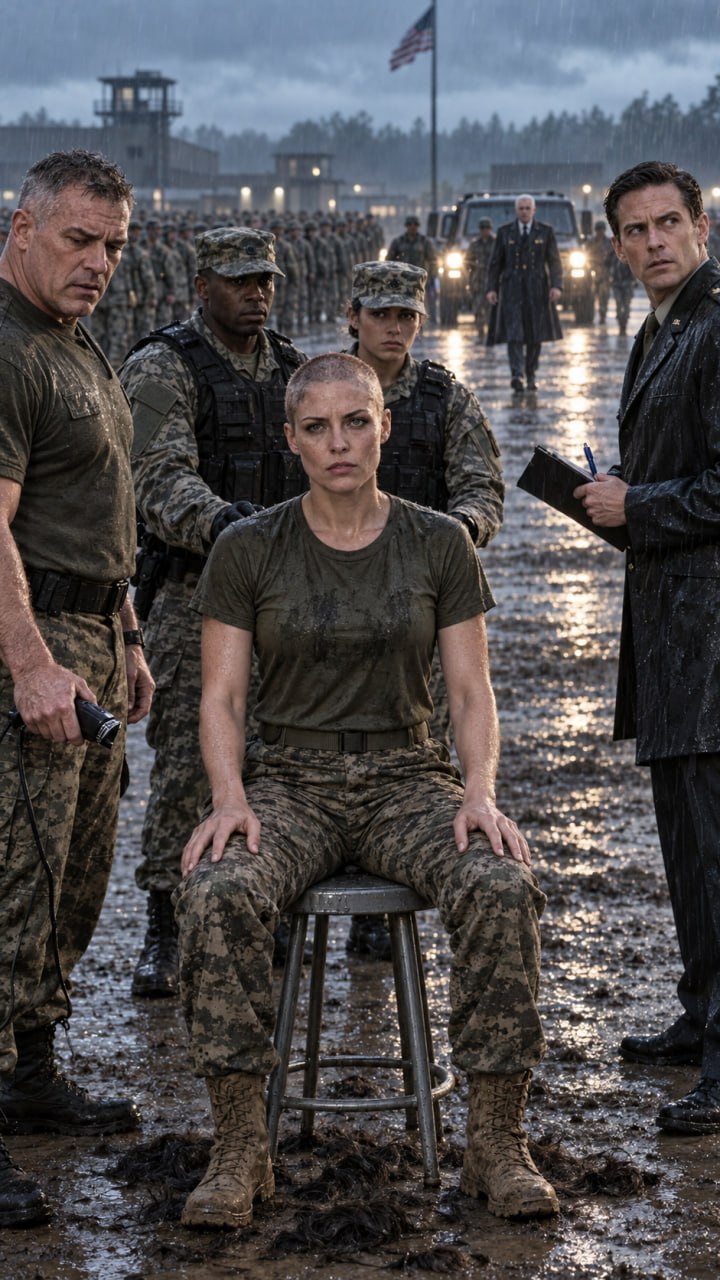
We turned the mess hall into an interview room before sunset.
Security pushed the stainless-steel tables against the walls and placed one long table beneath the center lights. Rain struck the high windows in uneven bursts. The kitchen had been closed, but the room still smelled of coffee, bleach, and the oatmeal I had cleaned from the floor that morning.
Ellery’s coat hung around my shoulders over the same wet uniform. I left my shaved head uncovered.
His aide suggested I change before the interviews began. She was being practical, not protective. Wet clothes recorded nothing. Hypothermia helped no investigation.
“Not yet,” I said.
If the recruits entered and found a polished investigator seated behind the table, they might decide the woman on the stool had disappeared with my cover. I needed them to see that both people were the same: the recruit who had been humiliated and the investigator asking them to trust a system that had already failed them.
At first, no one crossed the doorway.
Thirty recruits clustered in the corridor, close enough to see me and far enough to claim they had not volunteered. Their eyes moved toward the ceiling corners where cameras had watched meals for years. Security had disconnected the feeds, but fear did not disappear when a light went dark.
Ellery stood beside the kitchen doors. “We can compel statements.”
“Then we’ll get compliance,” I said. “Not truth.”
He studied the doorway. “How long?”
“Until the first person decides.”
We waited.
The clock above the serving line advanced six minutes.
Jensen stepped out of the group.
He carried the folded gray blanket against his chest. The blanket had stayed on my bunk after security sealed Barracks C. Someone had allowed him to retrieve it, or he had persuaded them that it mattered. Either way, he held it like evidence.
The corridor shifted behind him. A few recruits moved aside. Others looked down.
Jensen entered alone.
He crossed to the table, placed the blanket between us, and kept both hands on it for a moment. His fingers trembled against the rough fabric.
“Start with Barracks C,” he said.
I pulled out the chair opposite me. “Sit wherever you can see the door.”
He chose the end of the table, not the protected seat beside Ellery. From there, he could watch everyone who entered.
His first account came in fragments. The mattress. The locker. Knox’s instruction that no one help me. The threat to recycle the platoon. The four towels wrapped around soap. Each time Jensen reached Crowley’s name, his voice lowered.
“He can’t hear you from the administration building,” I said.
Jensen looked at the walls. “That’s what Parker thought.”
The name from the barracks whispers.
“Tell me about Parker.”
Jensen swallowed. “He complained after Miller got hurt. Crowley called him in alone. Next day Parker said he’d made everything up. Then he was gone.”
The mail clerk entered while Jensen was still speaking.
Ruiz took the chair beside him and placed her mail ledger on the table. The entry at 1342 confirmed that my letter had arrived through registered channels and been removed by Knox during official distribution. She described the lighter, the envelope, and Crowley’s position by the flagpole.
The two range assistants came next. The older one carried the broken radio inside a clear evidence bag. He identified the serial number, the condition at issue, and the moment Crowley released it over the concrete. The younger assistant admitted he had watched Crowley crush the casing and had said nothing.
“Why not?” Ellery asked.
The assistant stared at his hands. “Because the last man who contradicted him lost his medical clearance.”
The four recruits from the midnight attack entered together. Davis spoke first. The leader, Bell, corrected him twice, not to deny the account but to make it more exact. Knox had summoned them beside the laundry room. He had named the camera’s blind interval. The bruise on Bell’s jaw came from refusing the first time.
One of the MPs arrived after dark.
He no longer wore rain gear. Without it, he looked younger. He placed his phone on the table and opened a message from Crowley sent minutes before the shaving: Make the lesson public. Hold her still.
No one celebrated.
Statements accumulated in an orderly stack. Names filled pages that had once remained blank. The room changed one chair at a time. Recruits entered after seeing that the people before them had not vanished, been shouted down, or led away.
By 2100, we had thirty-seven signed accounts.
Jensen remained in his chair throughout. When the final witness finished, he looked at the stack and then at the blanket between us.
“Is that enough?” he asked.
“Enough to begin,” I said.
The answer frightened him. It also told the truth.
Fear remained in the mess hall. You could hear it in the pauses before names and see it in the way recruits checked the doorway. But it no longer decided who could speak.
For the first time, the room remembered out loud.
Comments (0)