The command Jeep stopped beside the flagpole.
Water spread from its tires in two shallow waves. The rear door opened, and General Marcus Ellery stepped into the rain wearing a dark command coat over his uniform. His aide followed with a secure tablet protected beneath her arm. Four members of his security detail exited from the second vehicle behind them.
Ellery took three steps toward the administration building before he saw me.
His pace stopped.
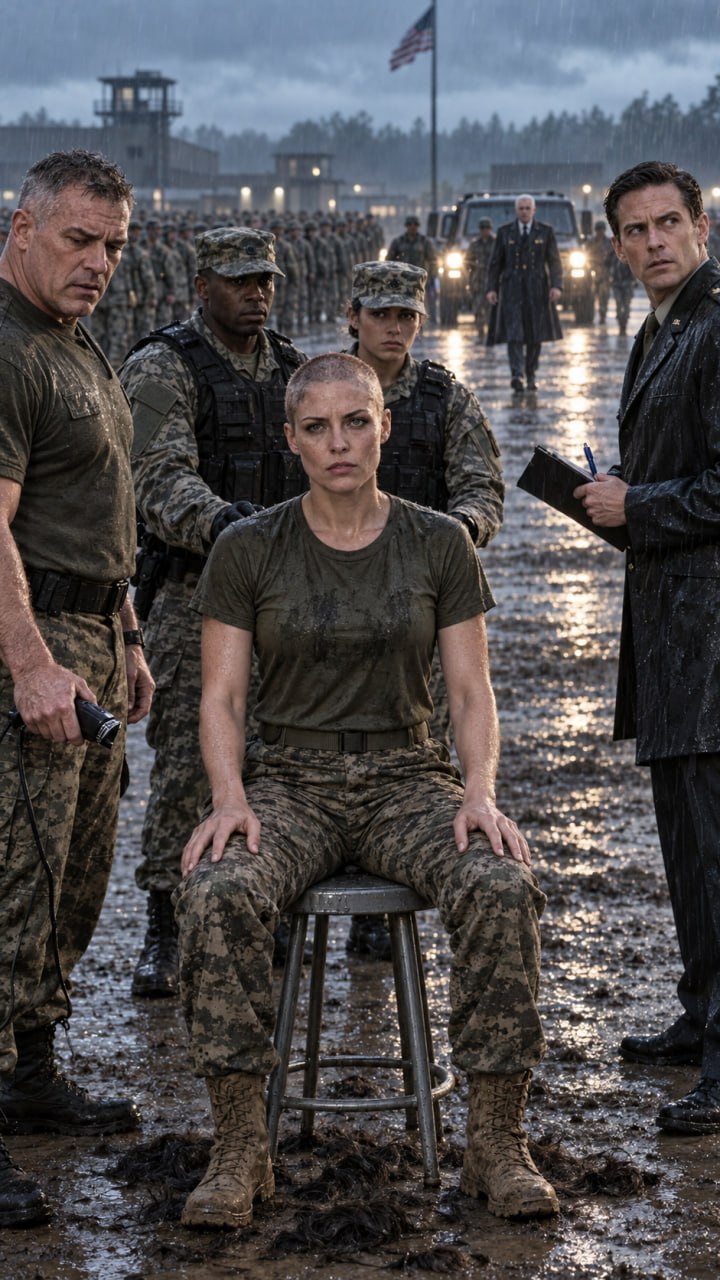
From where he stood, the arrangement required no explanation. A metal stool occupied the center of the deck. Wet hair lay scattered in the mud; two MPs held my arms, Knox carried clippers and mirror, Crowley recorded the scene, and an entire company had been forced to witness it.
The general’s face did not change dramatically. His anger never needed theater. One muscle tightened near his mouth, and the people who knew him began moving before he spoke.
Crowley did not know him well enough.
The major hurried across the deck with my thin personnel folder tucked beneath his clipboard. “General Ellery. We weren’t informed of an inspection.”
“You were not being inspected,” Ellery said.
Crowley missed the warning. He opened the folder as he approached. “Problem recruit, sir. No usable history, no qualifications, repeated insubordination. We were conducting corrective—”
Ellery held out his hand.
Crowley placed the folder in it.
For one second, relief returned to the major’s face. He believed the three visible pages would finish the argument for him.
Ellery glanced at them and turned to his aide. “Open the annex.”
She woke the secure tablet and held it between them. The screen requested credentials. Ellery placed his thumb against the reader, entered a code, and waited while a red clearance banner appeared.
Rain clicked against the glass.
The aide scrolled.
Ellery read the first page, then the next. His eyes moved faster as the classified file opened beneath my cover identity: assignments omitted from ordinary systems, investigative authorities, sealed operational citations, and the order placing Blackridge under preliminary review.
The color left Crowley’s face.
Knox lowered the clippers.
I watched Ellery reach the authorization page. He looked up at me.
Recognition alone was not enough. Our protocol required confirmation that the operation had reached its evidentiary threshold and that immediate intervention would not destroy a larger lead.
I gave one nod.
Ellery answered with a smaller one.
The exchange lasted less than a second. Crowley saw it anyway.
His confidence held for a fraction too long, then broke. He looked from the tablet to me, trying to rebuild the last three days around a fact that would not fit.
Ellery turned toward the MPs. “Release her.”
The man on my right opened his hand immediately. The other hesitated until Ellery’s security detail stepped forward, then released my arm and moved back.
Blood returned to my fingers in hot needles.
Knox found his voice. “General, she refused a lawful order and assaulted—”
“Stop talking.”
The command crossed the rain without being raised.
Knox stopped.
Ellery closed the thin folder. “Nobody touches Special Investigator Cross.” He looked toward the security detail. “Military Police, secure this command. Now.”
Two security officers moved to Crowley. Two moved to Knox. They did not tackle either man or create a spectacle. One officer took Knox’s clippers after establishing a grip; another removed the mirror from his hand. Crowley stepped backward until his heel struck the edge of the concrete.
“Sir, whatever that file says, this command has procedures.”
“You will have an opportunity to explain yours.”
Crowley looked toward the formation, perhaps searching for support, perhaps calculating how many witnesses could still be managed. What he saw were recruits watching him instead of looking away.
His fingers opened.
The clipboard fell face-up into the mud. The blue pen landed beside it.
For three days, that board had turned cruelty into documentation. Now rain spread the ink into thin blue veins across the page.
Ellery removed his command coat and placed it around my shoulders. He did not ask whether I was all right. Both of us knew the question was too small.
“Can you stand?” he asked.
I looked at the MPs, the recruits, and the hair darkening the mud beneath the stool.
“Yes, sir.”
I stood without assistance.
Jensen’s shoulders dropped. Ruiz covered her mouth. The older range assistant looked toward the broken radio case clipped at my side.
Ellery followed their eyes and understood that the scene in front of him was not the whole record.
“Seal the offices,” he ordered. “Preserve every file, camera archive, medical log, equipment report, and mail ledger. No one leaves until identities are recorded.”
The formation remained silent, but it was no longer Knox’s silence.
As security led Crowley toward the administration building, he looked back at me. There was no apology in his face, only the shock of discovering that the person he had treated as invisible had been the one person authorized to see him clearly.
His ruined clipboard stayed in the mud.
Comments (0)