General Cross did not hide from the document.
At the preliminary hearing, she testified first. Seven years earlier, she had reviewed an allegation that Rourke used unauthorized physical punishment. The only witness withdrew his statement, and Cross closed the case without examining why.
“I followed the minimum process,” she said. “That decision allowed the pattern to continue.”
Her admission removed the defense’s strongest argument that senior command was protecting itself.
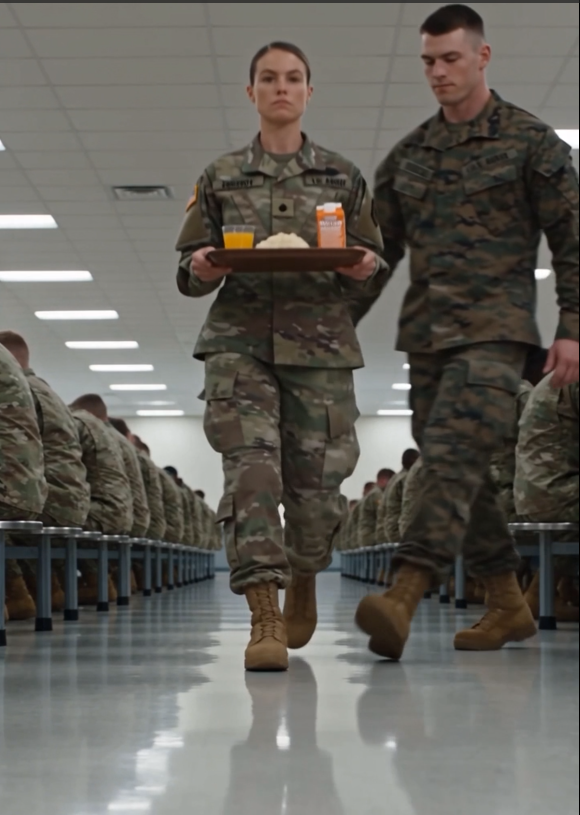
Rourke’s attorney attacked Nora’s undercover methods. He called the dining hall confrontation a staged test designed to provoke failure. Nora answered each question without anger.
The attorney displayed the edited online video and replayed Nora’s refusal several times. Ortega then produced the original file recovered from Mrs. Doyle’s cloud backup. Its continuous audio and wider frame showed Rourke changing direction before he struck the tray. The public story that had damaged Nora’s reputation collapsed in less than two minutes.
“Did you know Master Sergeant Rourke was under investigation?”
“Yes.”
“Did you intentionally conceal your rank?”
“Under written authorization.”
“Did you challenge him publicly?”
“I stated that he knocked down my tray.”
“And then you refused a lawful order.”
“An order to accept a false account is not lawful merely because it comes from someone with more stripes.”
Mrs. Doyle authenticated her video and notebooks. Ortiz described the equipment sales. The records clerk identified Danner and Pike. Financial investigators traced payments from Patriot Field Supply to Danner’s cousin.
Bennett testified from a chair because standing caused pain. He described the moment his legs failed in the rain and the hospital conversation that followed. Rourke watched the table throughout the testimony. When Bennett finished, several members of the panel remained silent before the next question.
Then Wade took the stand.
He admitted withdrawing Ortiz’s complaint. Rourke’s attorney tried to portray him as a dishonest man shifting blame to save his pension.
“I did act dishonestly,” Wade said. “That is why his system worked. He did not need everyone to be cruel. He needed good people to become afraid at the right moment.”
His retirement remained uncertain, but his testimony did not waver.
Bell testified next. His voice shook when he described Bennett’s collapse. Rourke stared at him from across the room.
For a moment, Bell lost his words.
Nora could not help him from the gallery. Bennett appeared on a screen beside the witness stand and placed one hand against the camera.
Bell looked at him, breathed, and continued.
The hospital recording filled the hearing room. Rourke’s voice threatened prosecution. Danner’s voice instructed him to keep the story simple. Bell’s secret recording then captured Danner ordering Nora’s reputation destroyed.
Danner tried to blame Rourke for the entire operation. Rourke responded by offering the missing financial ledger and describing Danner’s role. Each man attempted to save himself by confirming the guilt of the other.
The panel deliberated for two days.
During that wait, the witnesses gathered in a windowless room across the corridor. Nobody celebrated. Ortiz sat apart from Wade. Bennett rested his injured leg on a second chair. Bell remained beside him. They had told the truth, but each understood that the verdict could still leave them carrying its cost.
Rourke was convicted of assault, obstruction, retaliation, conspiracy, false official statements, and maltreatment of subordinates. He lost his rank, benefits, and freedom.
Danner faced separate convictions for conspiracy, fraud, obstruction, and conduct unbecoming an officer. Pike pleaded guilty after evidence connected him to the camera shutdown, cloned badge, attack on Bell, and archive fire.
The ruling also ordered an independent review of every disciplinary action, injury report, and involuntary separation connected to their command.
Outside the hearing room, reporters crowded behind a barrier. Nora avoided them and found Bell sitting alone on a bench.
“Is it over?” he asked.
“The hearing is.”
“That is not what I meant.”
Nora understood. A verdict could punish Rourke, but it could not return Bennett’s health or erase the months Bell had lived in fear.
“No,” she said. “Now we repair what they damaged.”
An aide approached with the first list of cases scheduled for review.
At the top was Eli Bennett’s medical discharge.
At the bottom was another name nobody recognized.
The soldier had died three years earlier.
Nora recognized the date. It appeared in Mrs. Doyle’s notebook beside four words written in capital letters: THEY CARRIED HIM OUT.
Comments (0)