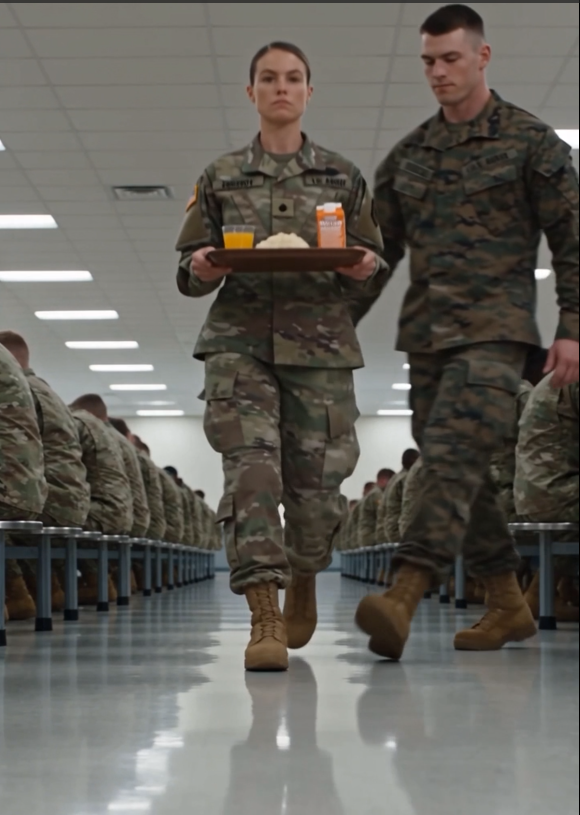
Rourke’s fear lasted only a moment. Then training and instinct rebuilt the mask he had worn for years.
“If the cameras were disabled,” he said, “you have no evidence beyond conflicting memories.”
Nora watched him straighten his collar. A man surprised by a technical failure would have looked confused. Rourke looked relieved.
“Nobody said they were disabled,” she replied. “Only that they stopped recording.”
His eyes tightened. He had revealed that he understood more than he should.
Captain Luis Ortega, the investigator holding the black folder, ordered the dining hall closed. Soldiers remained at their tables while names and seat locations were recorded. Phones were collected only from people who volunteered footage. No one was forced to surrender a device.
The first interviews exposed how carefully Rourke had trained the room. One soldier said he had been looking at his plate. Another remembered the sound but not the movement. A third began describing the elbow strike, noticed Rourke watching through the office window, and suddenly claimed he was unsure. Nora had the blinds closed before the next witness entered.
Mrs. Doyle raised her hand.
“I recorded part of it,” she said.
She had begun filming after Rourke silenced her. The video did not show him striking the tray, but it captured his command, his threat, and the moment Nora revealed her identity. More important, the audio contained several soldiers saying they had seen the collision.
Rourke was escorted to an empty office and temporarily relieved of supervisory duties. As he passed Bell’s table, he slowed.
“Be careful what you remember, Private.”
Nora stepped between them. “That sounded like a warning.”
“It was advice.”
“Then save it for your counsel.”
After he left, the dining hall filled with low, uncertain voices. The fear was no longer silent. Soldiers began comparing experiences and discovering that each had believed he or she was alone.
Bell remained standing beside his untouched meal.
“Ma’am,” he said, “the cameras did not fail by accident.”
Nora led him to a quiet corner with Ortega present. Bell explained that Rourke often met Staff Sergeant Travis Pike in the security room. Pike supervised physical access systems and knew the camera network. Two days earlier, Bell had delivered a maintenance form there and heard Rourke say, “Friday lunch will remind them who owns the room.”
“Why didn’t you report it?” Ortega asked.
Bell touched the bruise under his eye. “I tried to report something else.”
He would say no more.
Nora did not press him in front of the dining hall. She gave him a secure number and asked Ortega to arrange protective quarters. Bell looked at the card as if accepting it might be more dangerous than refusing it.
Across the room, Sergeant First Class Wade asked to speak privately. He looked older than he had an hour earlier.
“I failed to intervene,” he said. “I knew Rourke was wrong, and I stayed seated.”
“Why?” Nora asked.
“Because I have watched him destroy people.”
Wade described a complaint filed by Sergeant Lena Ortiz eight months earlier. Ortiz accused Rourke of forcing soldiers to buy unauthorized gear from Patriot Field Supply, a company owned by Rourke’s brother-in-law. The complaint reached Wade, who forwarded it through the chain of command.
The next morning, Rourke placed a draft evaluation on Wade’s desk. It accused him of poor judgment, weak leadership, and falsifying readiness reports. None of it was true.
“He told me the evaluation would disappear if Ortiz’s complaint did,” Wade said.
“What did you do?”
Wade’s eyes filled with shame. “I withdrew the packet.”
“Where is the original?”
“I kept a copy.”
For the first time, Nora saw hope.
Wade continued. “It was in a locked cabinet in my office. This morning, the cabinet was open and the file was gone.”
Ortega checked his phone. His team had already sealed the battalion offices, but Rourke’s administrative building had been unattended during lunch.
Nora ordered an immediate search.
They found no complaint in Wade’s cabinet. They did find fresh scratches around the lock and a single drop of brown gravy on the carpet inside the office.
Rourke had been wearing gravy on his boots when he left the dining hall.
But he had gone directly into custody.
Someone else had entered the office wearing the same evidence on their shoes.
Comments (0)