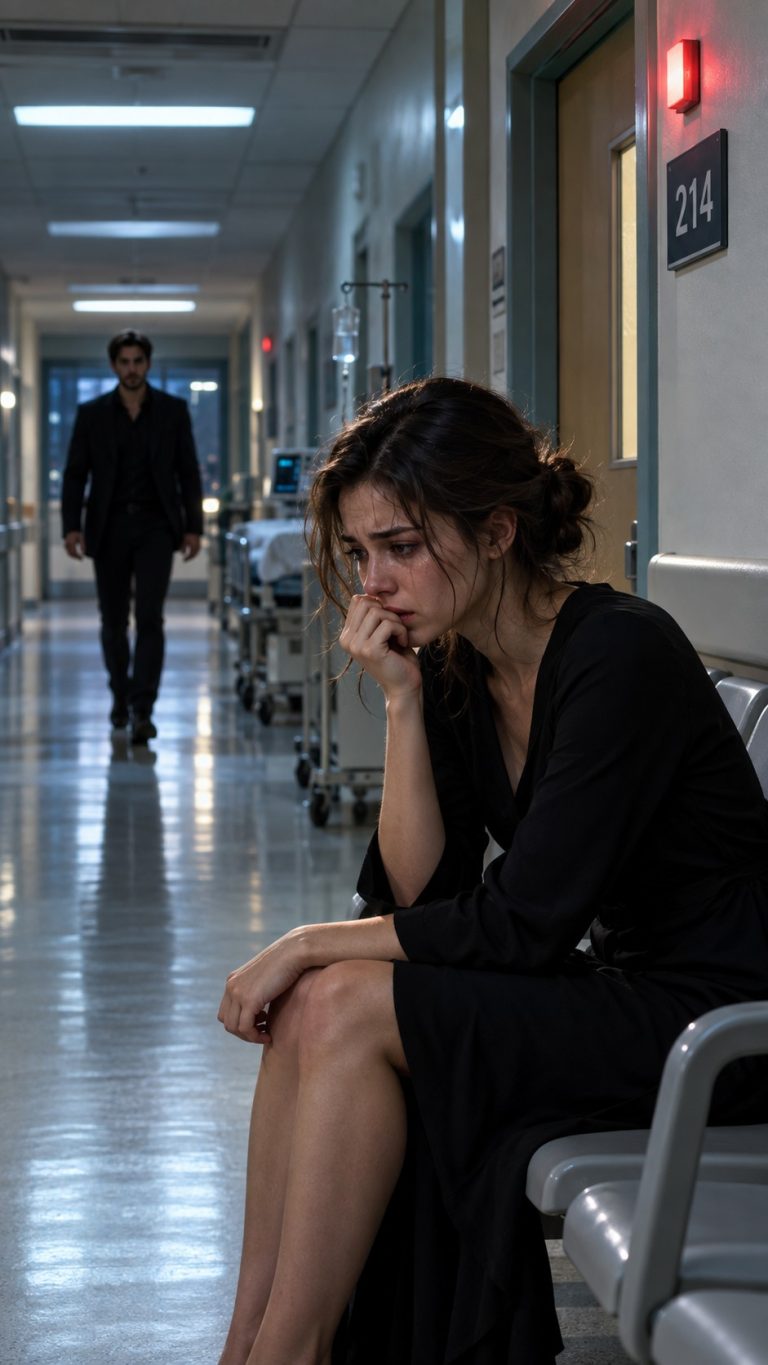
The apartment was still dark when Elena let herself in, the key turning softly in the lock. Dawn had not quite arrived; the windows were the color of weak tea, the light thin and uncertain. She kicked off her shoes and stood in the entryway for a moment, listening to the building settle around her — pipes ticking somewhere inside the walls, the refrigerator’s low hum, the muffled sound of a car passing on the street below. Her shoulder blades felt raw, the coat she had worn since Chicago was still on her body though she had taken it off twice already, and her hands were cold in a way that had nothing to do with the temperature.
Sofia was on the couch.
She had pulled a blanket over her lap and was holding a mug in both hands, staring at the screen of her laptop without looking at it. A half-empty glass of water sat on the coffee table next to a book she had not opened. She did not look up when Elena entered. She had been awake.
“Where have you been?” Sofia said, and the question came out flat, already knowing the answer was not simple.
Elena stood in the doorway a moment longer, her keys still in her hand, and considered the option of lying. It was always there. She had practiced it for twelve years, the careful construction of a smaller life around a missing piece, the polite fiction that allowed her to keep working, keep loving, keep paying rent. But the hospital had burned that skill out of her. The darkness of the stairwell had stripped whatever remained.
“Home,” she said. Then she walked further into the room and set her keys on the counter. “I’m home.”
Sofia set her mug down and turned toward her. Her face was tired in a way that made Elena think of her own face in the mirror some mornings, the tiredness of someone who has been waiting all night for a particular kind of news and has finally stopped expecting it to be good. “You missed your alarm,” Sofia said gently. “I called you twice before four and then I stopped trying. I couldn’t sleep.”
“I know.” Elena moved to the couch and sat on the far end, careful to leave space between them. The blanket was knitted, the kind Sofia had made during that winter Elena had almost moved to Portland and never did. Every stitch was a record of a conversation they had had in that room, over that couch, on nights when they had been close enough to touch and far enough away to pretend they weren’t.
Sofia put her mug down and folded her hands in her lap. She did not ask what had happened. She just waited, and Elena understood, in the way she had come to understand things she had not been taught, that this was what Sofia did better than anyone she had ever known: she made room for the unsaid thing without trying to pull it out.
Elena started with the wedding.
She told her about the darkroom and the twelve-year-old photograph, the one of her and Marcus at the rehearsal dinner, both of them smiling at something neither of them remembered anymore. She told her about the camera in her hands at the altar, how her fingers had shaken around the lens and she had pretended it was the cold. She told her about the corridor at the hospital and the way the lights had narrowed their hum like held breath. She told her about her father in the bed with the red light above the door, the old man breathing under the blanket, unaware she was there. She told her about Marcus and the things he had believed for twelve years, the guilt he had carried for something he had not done, and the moment — the only moment that mattered — when he understood it was never him.
“He thought I had ruined his life,” Elena said, and the words came out faster this time, almost light, as if the dead weight had finally broken its grip. “He thought I had found out something he did. He spent twelve years thinking he had done something wrong and I had walked away because of it. And it was my father. It was always my father, and he never knew, and I let him carry it alone.”
She stopped. Her mouth was dry. The kitchen clock on the wall read 5:47 and the seconds hand ticked forward with a sound that seemed too loud for how small it was.
Sofia did not speak. She sat very still, her hands folded in her lap, her face careful in a way that made Elena think she was holding her breath. Elena watched her watching her, and felt something loosen in the center of her chest, something that had been knotted since she was nineteen and had not known how to untie itself. She had told the truth to Marcus in a hospital corridor at two in the morning, and it had been the hardest thing she had ever done. She had told it to Sofia now, in a room with morning light coming through the window and a blanket on the couch and a clock ticking on the wall, and it was almost easier. Not easy. But almost.
“I knew something was wrong,” Sofia said finally. “I didn’t know it was this big.”
There was no anger in her voice. No accusation. Just the quiet observation of someone who had noticed the cracks in the wall and had decided, for reasons of her own, not to point at them until they were wide enough to see through. Elena looked at her, waiting for the rest of it — the I told you so, the where were you, the questions she had rehearsed in her mind a hundred times and never once in the right order.
Sofia reached out and put her hand on Elena’s knee. Her palm was warm. “You’re here now,” she said.
That was all.
Elena let out a breath she did not realize she had been holding, and something in the room shifted — not the air, exactly, but the shape of the silence between them, which was no longer the silence of waiting and was instead the silence of someone who had just been told a story and was deciding what to do with it. She had expected the worst. She had prepared for it, in the same way she had prepared for every difficult conversation in her life by imagining the worst outcome first and then trying to survive it. She had rehearsed Sofia’s anger, Sofia’s disappointment, the careful distance that would follow. She had not rehearsed this. She did not know what to do with it.
Her phone rang.
The sound came from the table where she had set it on the way in, the screen lighting up with a name she had not expected to see today and did not want to see at all. Victoria Caldwell. Elena stared at the screen, at the letters in that calm, ordinary font she had seen on invitations and thank-you notes and every piece of stationery the Caldwell family had ever used, and the phone rang again. Once. Twice.
She did not pick it up.
On the third ring, it went to voicemail — she had not checked her messages in years, but the light on the phone blinked anyway, a small red pulse in the dim morning room. Elena watched it, her hand still resting on her knee where Sofia’s hand had been, and the voicemail light kept blinking.
The call would not stop. Not really. Victoria Caldwell had heard something at the reception — a whisper from a relative, a look from someone who had noticed Elena and Marcus standing together too long that night before the ceremony, a coincidence that had become a story and a story that had become a problem. The Caldwell family did not let problems sit quietly. They called. They asked questions. They expected answers, and the answers they expected were the ones they had already decided were true.
Elena sat back on the couch and pulled her legs up beneath her, the blanket pooling around her ankles. She looked at the phone, at the blinking light, at the missed-call notification that had already appeared on the screen. Then she looked at the window, where the sky was turning from weak tea to something paler, the first pale blue light of morning working its way across the glass.
She should develop the photograph. She had the old negative in her bag still, the one from twelve years ago, the one she had pulled from the drawer in the hospital stairwell because she had not known what else to do with her hands. She could set it in the tray, watch the image emerge in the developer, the shapes of two people at a rehearsal dinner becoming clear again — both of them smiling, both of them unaware of what was coming. Then she could write the note. The one she had practiced in her head a hundred times and never once written down: I should have told you. Then she could drive to Marcus’s house again, past the hospital and past the corridor and past the door with the red light, and give it to him in person, and the words would be there on the back of the photograph where he could read them twice, once with his eyes and once in the quiet of his own room.
Her phone kept ringing. The voicemail light kept blinking. No answer came.
Comments (0)