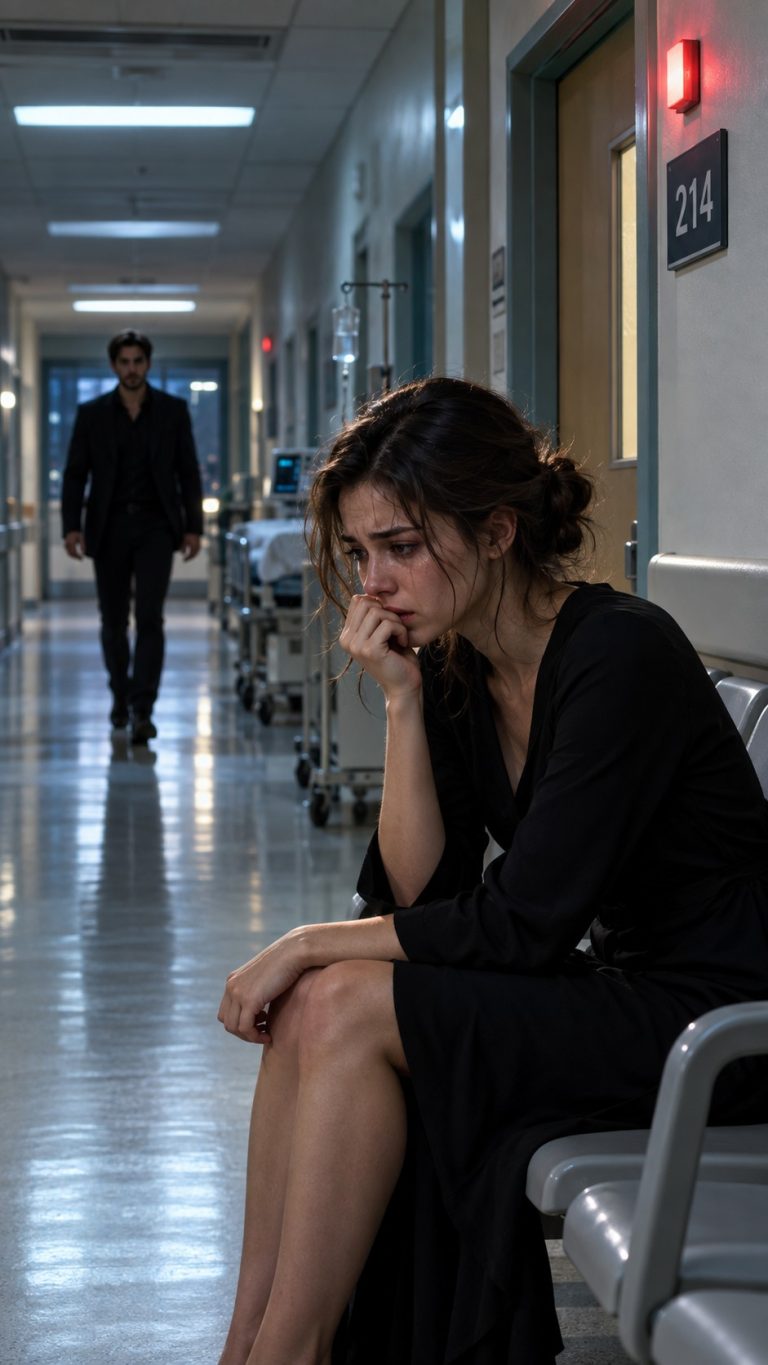
The first word was the hardest part.
“I—” Elena swallowed around it and tried again. “I found out my father had been stealing.”
The words came out in a rush, too fast, the way they always did when she was afraid of being interrupted. She stopped herself, pressing her lips together until they went pale. She looked at her hands, at the dark polish on her nails, chipped at the cuticle where she had bitten them that morning without thinking. She looked at the wedding dress underneath her coat sleeves — the ivory silk still hanging in her closet at home, the one she had never worn, the one she had packed away in a box and told herself was for a life that never got to happen. She took a breath that felt like it belonged to someone else, someone with more courage than she had managed to grow into.
“He had been embezzling from the company for years,” she said, quieter now. “Using the money to pay my mother’s medical bills. I found out when I was going through the books, two weeks before the wedding. She had been sick for a long time and we had never talked about it, not really, and when I saw what he had done — what he had taken — I realized the company would collapse. Everyone who worked there would lose their jobs. My mother would lose her coverage. There was no way to stop it without telling everyone, and if I told everyone, I would have to tell you, and if I told you, I would have to tell you why I couldn’t marry you right then, and I was nineteen and I was proud and I was terrified and I thought if I just left without explaining, the whole thing would stay suspended. Like it could not quite touch anyone.”
She stopped. Her throat tasted like copper. The dress sleeves felt heavy on her forearms, the weight of something she had carried for too long and had forgotten was still there.
The corridor had gone very quiet. Even the lights seemed to have narrowed their hum, pulling inward like held breath. Somewhere down the hall, a television played without sound, blue light flickering against a wall of framed patient certificates no one had looked at in years.
Marcus did not move. He did not interrupt. He just listened, his face unreadable in the fluorescent light, his hands hanging loose at his sides, fingers slightly curled as if he were holding something that wasn’t there. Elena watched him watching her, and understood for the first time that he had been carrying something all these years that she had never given him.
“I thought I’d done something,” he said.
The words were so low she almost missed them. She turned toward him.
“I thought I’d found out about something I was involved in,” he said. “Somewhere in those months before the wedding, I thought maybe I had seen something — a document, a conversation, something I shouldn’t have seen — and that’s why you left. I thought I had done something wrong and you had found out and I hadn’t even known.”
He looked down at his hands again, the same gesture she had made a hundred times in the years that followed, trying to make sense of a puzzle that had no pieces. There were faint scars on his knuckles — old paper cuts, a faded mark from something sharp, things that made her think of offices and desks and the shape of a life lived in rooms with fluorescent lights.
Elena stared at him. The hallway seemed to tilt again, but this time not away from her. Toward something she had not seen in twelve years.
“You had nothing to do with it,” she said. “You never did.”
Marcus sat with that for a long moment. He looked down at his hands, then back up at her, and there was something in his face that she had not seen before — not forgiveness, not exactly, but the beginning of something that might become it if she gave it time. Something unclenched behind his eyes, a slow release she could feel in the air between them.
“You idiot,” he said.
There was anger in it. There was love. There was something that looked almost like relief, as if a weight he had been carrying had finally slipped and he did not quite know what to do with his hands now that they were empty. He flexed his fingers, once, then let them fall to his sides again.
“I spent twelve years thinking I had ruined your life,” he said. “Thinking I had done something that made you run. And all this time, it was your father. It was always your father.”
Elena did not answer right away. She looked at the door to her father’s room. The red light above it was still red, a small ember in the fluorescent wash, blinking in a steady rhythm that matched nothing she could name. Her father had settled back into the pillow; she could not hear him anymore, but she knew he was there, an old man breathing in a room at the end of a corridor, paying for something in the only currency he had left. A guilty man who had spent decades paying with other people’s money and had finally run out of everything else.
“I know,” she said.
He nodded, once. Then he stood up. His chair made a soft scrape against the floor, the first sound that belonged to him and not to the corridor. “I’m not going to pretend this fixes anything. But I needed to hear it.”
“Elena,” he said.
“Yes.”
“Your name. I meant to ask you earlier and I keep forgetting to say it out loud.”
She told him.
He nodded again, like he had been waiting for the sound of it. Like the syllables had been waiting for him to catch them. Then he walked away down the corridor, past the nursing station with its blank computer screen and its stack of unread paperwork, past the ice machine that hummed in the corner and rattled every few seconds like a tired engine, past her father’s door. He did not look back. His footsteps were quick on the linoleum, then slower, then gone.
Elena did not follow. She sat in the chair until the vinyl stuck to her thighs and the lights hummed and her father stirred again, a small shift under the blanket, the rustle of cotton and the soft groan of an old body finding its position. He did not wake. She stayed until the nurse came through the corridor with a clipboard and asked her name and she told her, and then she got up and walked to the back stairwell and went down two flights before anyone could ask her anything else.
The stairwell door closed behind her with a heavy latch. The air was cool and smelled like dust and old concrete and the faint chemical bite of the cleaning supplies used on the floors below. She leaned against the railing, the metal cold through her coat, and breathed. Down below, somewhere, a freight elevator clunked and groaned and settled.
She looked down the stairwell, step after step, concrete and painted steel and the smell of a building that had been here longer than anyone in it. She kept going until she reached the ground floor and pushed through the exit door and out into the afternoon, into the parking lot, into the space where she could finally decide what came next. And for the first time in twelve years, the room inside her chest felt like it belonged to her again.
Comments (0)