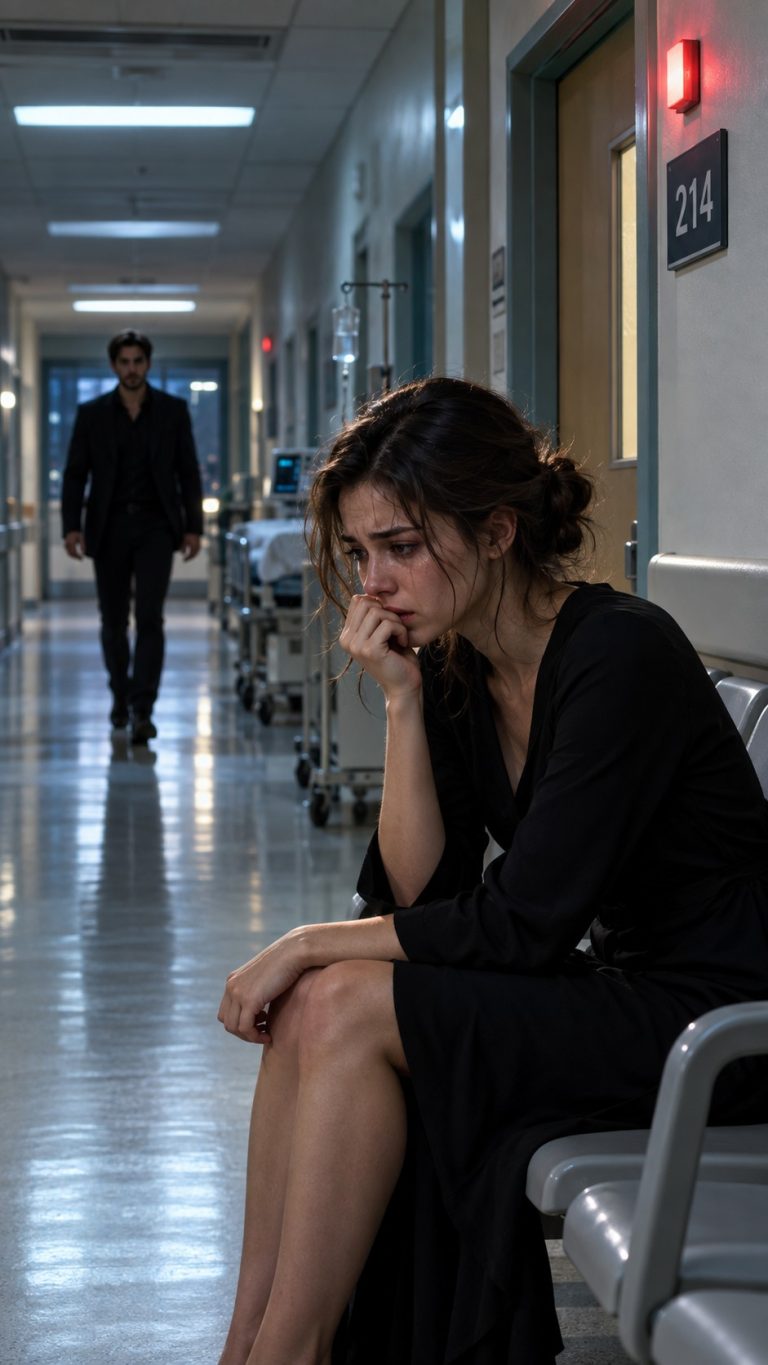
The envelope sat on Elena’s nightstand until 2 AM, white and ordinary-looking, the single line in blue ink the only thing about it that was not ordinary at all. She had written it and put it away, and now she was awake again, staring at the ceiling and listening to the refrigerator hum through the wall.
She had told herself she was going to sleep. She had told herself this in the darkroom, in the car, in the restaurant where she had sat with her camera on a table and watched Marcus laugh at something Claire had said. She had told herself a lot of things. None of them worked.
At some point she got up and turned on the bedside lamp and looked at the envelope again. The handwriting was hers. She knew the shape of every letter she ever wrote — the slight backward slant, the way the S curved too far — and seeing it on paper felt less like reading than recognizing herself from a distance.
I should have told you.
She had not addressed the envelope to anyone. She had not sealed it. It was not a letter. It was something else — a record of something that had happened inside her, written down because it would not stay inside otherwise.
She turned off the lamp and lay back down. In the dark she could feel the contact sheet still under the red light in her darkroom, the frame of Marcus laughing, the frame she had not meant to take. She could feel the next day waiting for her — the church, the aisle, the moment when she would stand behind her camera and watch someone else say the words she had once expected to hear from him.
At 2:47 she got dressed again and drove west.
The care facility was in a part of the city she did not know well — a strip of low buildings behind a row of elm trees, the kind of place you only noticed if you were looking for it or had been sent there by someone who already knew where it was. Elena sat in the visitor’s parking lot with the engine running and her camera bag on the seat beside her, and she watched the entrance through the windshield.
No one was coming to meet her. She had not told anyone she was coming. That was the point, she thought. Or one of the points. She was about to do something she had not done in six months — visit the man who had ruined the last twelve years of her life and see if there was anything left to ruin.
She got out of the car and walked toward the building. The automatic doors slid open in front of her. Inside, the air was warm and smelled faintly of bleach and coffee. A woman behind a desk looked up when she approached and asked if she was looking for someone, and Elena said yes, Robert Torres, and the woman typed on a keyboard and nodded and said he was on the third floor, Room 312.
Elena took the elevator without speaking to anyone else. The woman at the desk had not seemed surprised, which she took as a kind of information — not confirmation, not denial, just the absence of surprise, which suggested that other people had done this before her.
Room 312 was at the end of a hallway lined with identical doors. Elena stood outside it for a moment and listened. There was a television playing inside, turned low, the sound of a game show she could not quite hear. Somewhere down the hall, a nurse called out a name.
She knocked and opened the door.
Robert Torres was in a bed near the window. He was smaller than Elena remembered — the man who had run a company, who had signed his name on checks and agreements and promises, had shrunk into the width of a hospital bed. The ventilator beside him had a plastic tube that breathed for him in slow mechanical rhythm. His hands, resting on the blanket, were spotted and thin, the knuckles prominent.
He was looking at the ceiling. She said his name.
His eyes turned to her slowly. For a moment he did not seem to know who she was — the shape of her face registered and then dissolved, and then something else happened, something in the middle distance between recognition and the fog. He blinked.
“Elena,” he said. The word was quiet. He tested it the way you test a chair before you sit down.
She pulled the visitor’s chair closer to the bed and sat down. She had not brought anything — no flowers, no letters, no prepared speech. She had the camera bag in the car and the envelope in her drawer and nothing else that would have helped.
“You came,” he said.
“I came.”
He looked at her for a long time. His eyes were cloudy at the edges. “You look well.”
“I’m fine.”
“I was — I was worried about you. After —” He stopped. The words were there and then they weren’t. “After everything.”
Elena did not answer right away. She looked at his hands. She looked at the thin skin over his wrists, the pale blue veins, the wedding band that had slipped loose and was held in place now by a rubber band someone had tied around it.
“I’m sorry,” he said.
He said it once, and then he said it again, and on the third time it was almost a question. Elena waited.
“Sorry,” he said, slower now, and his eyes were on something between her face and the window. “For all of it.”
She did not know which part he meant. The money. The silence. The years she had not visited. The thing he had done to her family or the thing he had failed to do or the thing that was none of it and everything of it at once. She looked at him and tried to find a response that would not require her to say the words she had been carrying for twelve years.
“It’s okay,” she said, and heard how small it sounded.
He shook his head. Barely — a movement so slight she might have imagined it. “No,” he said. “Not okay.”
She sat with him for twenty minutes. She watched the television through the corner of her eye, a game show with a bright plastic set, people in colored blazers laughing at questions they already knew the answer to. She listened to the machine breathe beside the bed. She watched her father’s eyes move — sometimes toward her, sometimes past her, sometimes closed entirely — and she did not speak except to answer the questions he asked, which were few and did not make much sense. Is it raining? Do I have a son? Did I lock the door?
When she left, he was asleep.
She walked back to the car in the dark parking lot. The building behind her was quiet. The elm trees had dropped their leaves on the windshield. She got in and started the engine and sat there for a moment with her hands on the wheel and her forehead against the steering wheel.
She had gone there intending to say something — to begin the thing she had been carrying, to let some of it out into a room where no one would be hurt by it except the man who had already been hurt by everything. She had not said anything. She had sat in a chair and listened to a man she barely recognized say sorry to the air.
On the drive back, she found herself heading in a different direction than the one she had planned. She had turned west, away from the city center, away from the direction of her apartment — and now, without making a decision, she was driving east, toward the north side, toward the neighborhood where Marcus lived, wherever that was. She had not looked it up. She had never needed to know.
The streetlights passed over the windshield. The radio was still off. Her hands were on the wheel and the camera bag was on the passenger seat and she was thinking about a wedding that would happen in six hours and a man she had not told the truth to in twelve years.
She drove three blocks past the last recognizable landmark and then, at an intersection where she could have turned onto the street she thought was his, she did not turn. She sat at the light and watched the cross traffic pass and waited for the light to change and then kept driving straight.
She went home.
The apartment was dark. She unlocked the door and stepped inside and did not turn on the lights. She took off her coat and set it on the chair and stood in the darkness for a moment, listening to the refrigerator hum through the wall — the same sound she had heard an hour ago, the same sound she would hear tomorrow morning.
She went to bed. She slept in fragments — brief periods of actual sleep interrupted by moments when she was awake and staring at the ceiling and aware, with a kind of dull clarity, that the next twelve hours would not be like any twelve hours she had planned for herself.
She woke before dawn. The light through the blinds was the color of something barely beginning. She got up and showered and dressed in the clothes she had laid out the night before — dark jeans, a black sweater, shoes that would not hurt her feet by noon. She packed the camera bag. She checked the lenses twice. She put the contact sheet from the rehearsal in her portfolio case along with everything else.
At the door she paused and looked back at the room. The envelope was still in the drawer where she had put it. The photograph was still there too — the one from twelve years ago, the rehearsal dinner, the two of them smiling before she walked away from everything.
She did not take either one.
She locked the door and went to her car. The city was quiet. The sky was still dark. She drove toward the church with her hands on the wheel and her camera bag beside her and told herself, all the way there, that she would do the job the way she always did — show up, set up, shoot, develop, deliver — and then go home and never think about it again.
The wedding was in six hours.
She pulled into the parking lot and sat for a moment with the engine running. The church was a white stone building with a steeple she could not see yet from this angle, and there were already cars in the lot — early arrivals, family members, people who had been planning this day for months. She turned off the headlights and waited in the dark, and then she got out and lifted her camera bag over her shoulder and walked toward the door.
Comments (0)