The dead soldier’s name was Private Daniel Cho.
His death had been classified as a training accident, but Mrs. Doyle’s notebooks placed him in the dining hall hours earlier with a swollen wrist and mud covering his uniform. A newly reopened medical file showed signs of heat illness after an unauthorized punishment exercise.
Daniel’s family had spent three years believing no one knew the truth.
Nora visited them with General Cross. They did not offer excuses. They explained what the review had found and listened while Daniel’s mother described the last phone call from her son.
The Army corrected the record and referred two additional officers for investigation. Nothing could make the family whole, but the truth no longer belonged to the people who had hidden it.
Fort Redstone changed slowly.
Disciplinary reviews could no longer be controlled by one chain of command. Soldiers gained a confidential reporting channel outside their units. Camera outages in common areas required automatic notification to installation security. Financial relationships involving preferred vendors received independent review.
Policies alone did not restore trust. People did.
Wade received an official reprimand for withdrawing Ortiz’s complaint. He did not lose his retirement, but he spent his final year training junior leaders to recognize retaliation and preserve evidence. He began every class by describing the moment he remained seated in the dining hall.
“Courage delayed can still matter,” he told them. “But someone pays for every minute you wait.”
Ortiz did not forgive him during their first conversation. She did, however, agree that his statement could be used to reopen other cases. Wade accepted the difference. Accountability did not guarantee reconciliation, and testimony did not erase the harm that made it necessary.
Mrs. Doyle returned to work after the installation canceled the contractor’s retaliation against her. Soldiers placed a new notebook beside her cash register on the first morning back. On its cover they had written, For the things that must not disappear.
Bell was cleared of every false allegation. The Army reimbursed the money he had paid for unauthorized equipment and restored the leave Rourke had denied. He used it to visit Bennett in Ohio.
They sat on Rachel Bennett’s porch for hours. Bell apologized again. Bennett finally told him to stop.
“You came back,” Bennett said. “Help me do the same.”
Months of rehabilitation followed. Bennett would never return to active duty, but the correction of his record restored benefits and opened a civilian position supporting injured service members. On his first day, Bell sent him a message containing only four words.
Still standing with you.
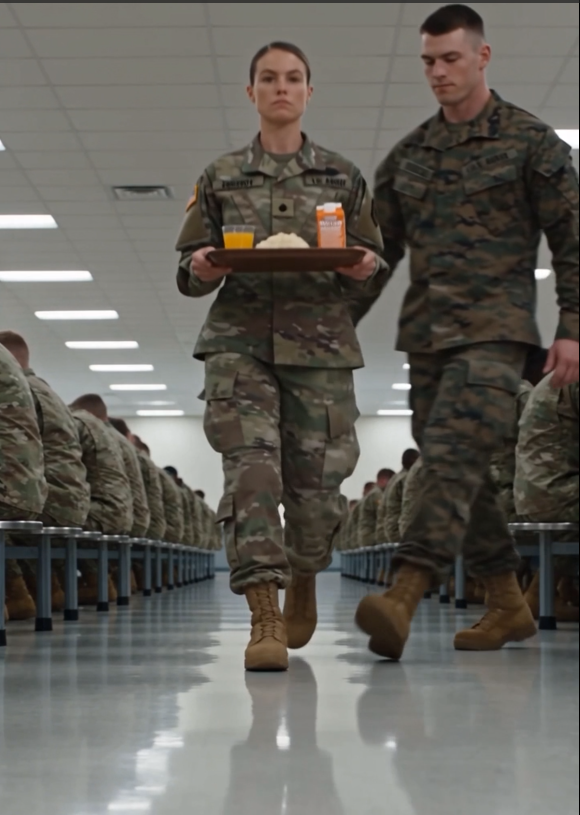
Nora returned to the Fort Redstone dining hall six months after the incident. The room looked almost unchanged. Trays moved along the serving line. Coffee still tasted burned. Young soldiers still rushed through lunch as if five extra minutes might save the day.
Yet conversations no longer stopped when a senior NCO entered.
Bell, recently promoted to specialist, noticed Nora and stood. She was wearing her real rank now. Silver oak leaves rested openly on her uniform.
Mrs. Doyle placed a tray in Nora’s hands. “Try to keep this one off the floor, Major.”
Nora smiled. “No promises.”
As she turned, a nervous private collided with a chair and dropped a cup. The sound cracked across the dining hall.
The young soldier froze.
A platoon sergeant nearby walked over. For one terrible second, the private seemed to expect the old response.
The sergeant picked up the cup.
“Accidents happen,” he said. “Grab another one.”
Conversation resumed.
Nora carried her tray to Bell’s table. On the wall behind him hung a framed copy of the installation’s new leadership standard. The language was simple: authority would be judged by how it treated those with the least power to resist it.
Bell glanced at the silver oak leaves on Nora’s collar.
“When Rourke knocked down your tray, were you afraid?”
“Yes.”
He looked surprised. “You did not seem afraid.”
“Courage is not the absence of fear. It is deciding that fear does not get the final order.”
Bell considered that, then looked around the room where soldiers now spoke without constantly checking who might be listening.
Nora had entered Fort Redstone pretending to be nobody important. Rourke believed that made her powerless.
His mistake was larger than failing to recognize an investigator.
He believed dignity belonged to rank.
The people he tried to silence proved it belonged to everyone.
Comments (0)