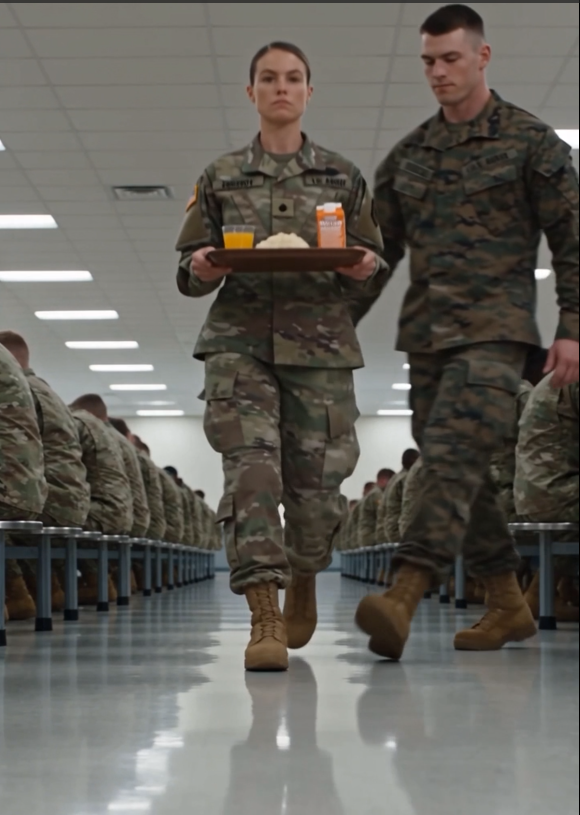
The gravy sample led Nora’s team to Staff Sergeant Pike.
Pike had stood near Rourke when the tray fell. He had also left the dining hall through the kitchen before the doors were secured. When investigators found him, a brown stain marked the tread of his right boot.
He claimed it came from stepping through the spill.
The dining hall’s seating map proved otherwise. Pike had been twenty feet away.
His access card showed that he entered Wade’s office seven minutes after the incident. It also showed that he entered the camera room shortly before lunch.
Pike was suspended from his duties, but he refused to answer questions without an attorney. The missing complaint was not on him, in his vehicle, or inside his office.
Nora returned to Wade’s damaged cabinet. The drawer held years of routine documents, but the dust along the back panel had been disturbed. When Ortega removed the drawer, he discovered a narrow envelope taped beneath it.
Inside were photocopies of purchase receipts from Patriot Field Supply. Thirty-two soldiers had bought the same “required deployment kit” for $480 each. The equipment was never listed in official policy and several items failed safety standards.
There was also a handwritten list of names and amounts.
Bell’s name appeared beside the number 960.
“Why twice?” Nora asked.
Wade shook his head. “I don’t know.”
Bell did.
When shown the document, he admitted he had purchased one kit for himself and another for Private Eli Bennett, his roommate. Bennett could not afford the equipment, so Bell used money his mother had saved for his younger sister’s college application fees.
Bell had told his family the Army required the purchase. His mother worked two extra weekend shifts at a nursing home to replace the money. Bell carried that knowledge with him whenever Rourke accused the young soldiers of lacking commitment.
“What happened to Bennett?” Nora asked.
Bell’s hands closed into fists. “He is gone.”
Six months earlier, Rourke had accused Bennett of losing a piece of night-vision equipment. Bennett insisted he had returned it. Rourke ordered him into a series of unofficial corrective drills after midnight: heavy carries, repeated sprints, and hours outside in freezing rain.
Bennett collapsed.
The medical report described dehydration and accidental exposure. The unit log claimed he had trained alone without authorization.
“That was a lie,” Bell said. “Eight of us were there.”
“Why did you sign statements saying he was alone?”
Bell’s eyes moved toward the door. “Rourke told us Bennett would face criminal charges for the missing equipment. He said if we supported Bennett, we would be charged too.”
Bennett survived, but nerve damage in his left leg ended his military career. He returned home to Ohio and stopped answering calls from the men who had watched him fall.
Bell’s bruise came from his latest attempt to retrieve the truth. He had confronted Pike after discovering that the missing night-vision device had been logged into a different unit’s storage room. Pike struck him and warned him to forget the serial number.
“Do you still have it?” Nora asked.
Bell recited the number from memory.
The investigation expanded before sunset. Records connected the device to a false loss report approved by Rourke. The supposed loss had justified charging Bennett while concealing a transfer of equipment between units.
Nora believed the paperwork scheme went beyond one abusive master sergeant. Rourke could intimidate soldiers, but he could not alter inventory databases, medical findings, and evaluation files alone.
Ortega compared user histories from three systems. Each alteration had been approved with a different account, yet all occurred during narrow windows when Colonel Danner’s executive assistant scheduled closed staff meetings. The pattern divided responsibility so no single audit would reveal it.
At 8:40 that evening, she entered Rourke’s office with Ortega and a legal observer. One wall displayed commendations. Another held photographs of Rourke shaking hands with senior commanders.
Behind the desk hung a framed picture of Rourke beside Colonel Adrian Danner, Fort Redstone’s deputy commander.
Ortega opened the bottom drawer and found a false wooden panel. Behind it lay a black ledger filled with initials, dates, and dollar amounts.
Several entries matched purchases from Patriot Field Supply.
The final page had been torn out recently.
Only the pressure marks from the missing writing remained.
Nora angled a light across the paper. A name slowly appeared in the indentation.
AD Danner.
Then the lights in the building went out.
Comments (0)