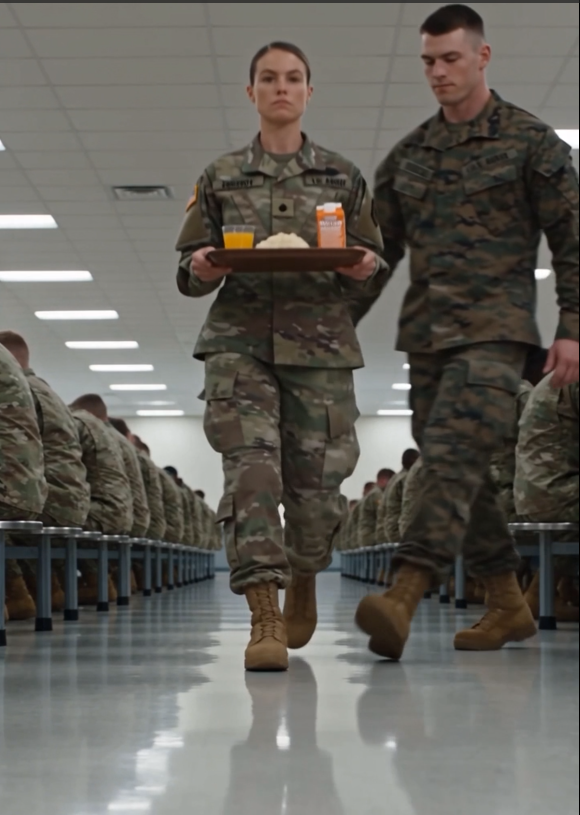
“Soldiers who cannot carry a tray should not be trusted with a rifle.”
Master Sergeant Victor Rourke’s voice cut through the crowded dining hall a second after Specialist Nora Hale’s lunch struck the floor.
The tray had not slipped. Rourke had driven his elbow into its edge while forcing his way past her. Chicken slid beneath a table, green beans scattered across the aisle, and dark gravy spread around Nora’s boots. Everyone close enough had seen it, yet most of the soldiers lowered their eyes.
Rourke pointed at the mess. “Clean it up.”
Nora stayed upright. Her uniform carried specialist insignia and an unfamiliar temporary assignment badge. She had been at Fort Redstone for twenty-two days, quiet enough to be overlooked and new enough to have no obvious allies.
“You knocked it from my hands, Master Sergeant.”
The room went still.
Rourke stepped closer. He was broad, decorated, and practiced at turning cruelty into procedure. Complaints against him always disappeared. Witnesses revised their statements. Counseling forms appeared with convenient dates. By the time senior officers asked questions, the person Rourke had targeted looked like the problem.
“You stepped into me,” he said. “Now pick up what you dropped.”
Private First Class Owen Bell watched from the nearest table. A fading bruise shadowed his left eye. The week before, he had told Nora he walked into a cabinet. Rourke had stood beside him while he said it.
Behind the serving counter, Mrs. Evelyn Doyle gripped a dish towel. “He hit her tray,” she said.
Rourke turned. “This is a military matter.”
“It happened in my dining room.”
“You are a contractor. Remember your place.”
Mrs. Doyle looked away, and satisfaction touched his face.
Nora had seen that expression many times during her assignment. Rourke collected public surrenders. A lowered gaze, a frightened apology, a soldier accepting blame to protect a career: each small victory strengthened the fear around him.
She had also learned how fear changed a room. Soldiers laughed too loudly when Rourke told a joke. They volunteered for extra duty before he could assign it as punishment. When he entered a hallway, conversations became harmless. Nobody discussed injuries, missing money, or the evaluations that appeared whenever someone resisted him.
“Ten seconds,” he told Nora.
She placed the empty tray on a table. “Are you certain you want ten more seconds of attention?”
He studied her more carefully, but her temporary file showed nothing important. She appeared to be a junior soldier assigned to administrative work. That was the cover authorized by the Army’s Command Accountability Division.
For three weeks, Nora had listened as soldiers described missing equipment charges, canceled leave, punishment details, and reports rewritten under pressure. Rourke became respectful whenever senior leaders entered a room. He believed rank mattered most when the other person had less of it.
Nora began rolling the black compression sleeve from her right forearm. A small sword-and-laurel mark appeared near her wrist, followed by a six-character identification code.
Rourke recognized it.
His smile vanished.
Nora felt no satisfaction. Exposing the symbol meant her quiet work was over. From that moment onward, every frightened soldier would have to choose whether to speak while Rourke was still close enough to retaliate. Her rank could open an investigation. It could not make courage painless.
Three soldiers near the rear exit rose together. They wore ordinary uniforms without unit patches, just as Nora did. One secured the doors. Another went toward the camera office. The third approached with a black folder.
“There has been a misunderstanding,” Rourke said.
“A moment ago, you were certain there wasn’t.”
The folder opened. Inside lay Nora’s official identification and orders.
Rourke stared at the badge. “Inspector General.”
“Major Nora Hale,” she said. “Command Accountability Division.”
Private Bell stood. Then Sergeant First Class Marcus Wade rose from beside the coffee station. Others followed, encouraged by the first visible fear they had ever seen on Rourke’s face.
“You planned this,” Rourke said.
“I planned to observe you. You chose the rest.”
Witnesses began speaking. Mrs. Doyle repeated what she had seen. Bell said Rourke had struck the tray deliberately. A corporal confirmed the threat. The accounts came from every side of the room.
Some were small stories that would never have produced an investigation alone: a missed medical appointment, a weekend pass canceled without explanation, a public joke about a soldier’s reading difficulty. Together, they revealed the daily machinery of control that formal reports had failed to capture.
Rourke looked toward the ceiling cameras.
Nora pointed at the food around his polished boots. “First, you are going to pick up what you knocked down.”
He did not move.
One of Nora’s investigators returned from the security office and whispered in her ear.
The cameras had stopped recording four minutes before the tray fell.
Someone had known the confrontation was coming.
Comments (0)